
AI Fluency - The New Digital Literacy
A Framework for Human AI Interaction

When I was studying Software Engineering at university, one subject stood out to me as truly fascinating: Human-Computer Interaction (HCI). This field explores our relationship with machines and the design of user-centered interfaces that shape how we interact with them.
That lecture became the inspiration for my final-year project: building a Virtual Reality (VR) user interface for accessing documents on a computer.
That was 30 years ago. Fast forward to today, HCI is still very much alive—but the “computer” itself has transformed.
Now, not only can we talk to the machines, but they can talk back in ways that would make Turing turn in his grave.
Today, we are entering the age of Artificial Intelligence. And with it, HCI is evolving into HAI (Human-AI Interaction).
Just as fluency is essential when speaking with another person, the same is true when communicating with AI. To make the most of it, we need something new: AI Fluency.
The term ‘AI Fluency’ was first coined by Professors Rick Dakan and Joseph Feller through their collaborative research on human-AI interaction titled ‘Framework for AI Fluency’ (2025).
The collaborative work defined AI Fluency as:
“The ability to work effectively, efficiently, ethically, and safely within emerging modalities of Human-AI interaction”
The 3 A’s of Human–AI Interaction
The modalities in the above definition represent the 3 stages of increasing sophistication in how humans interact with AI.
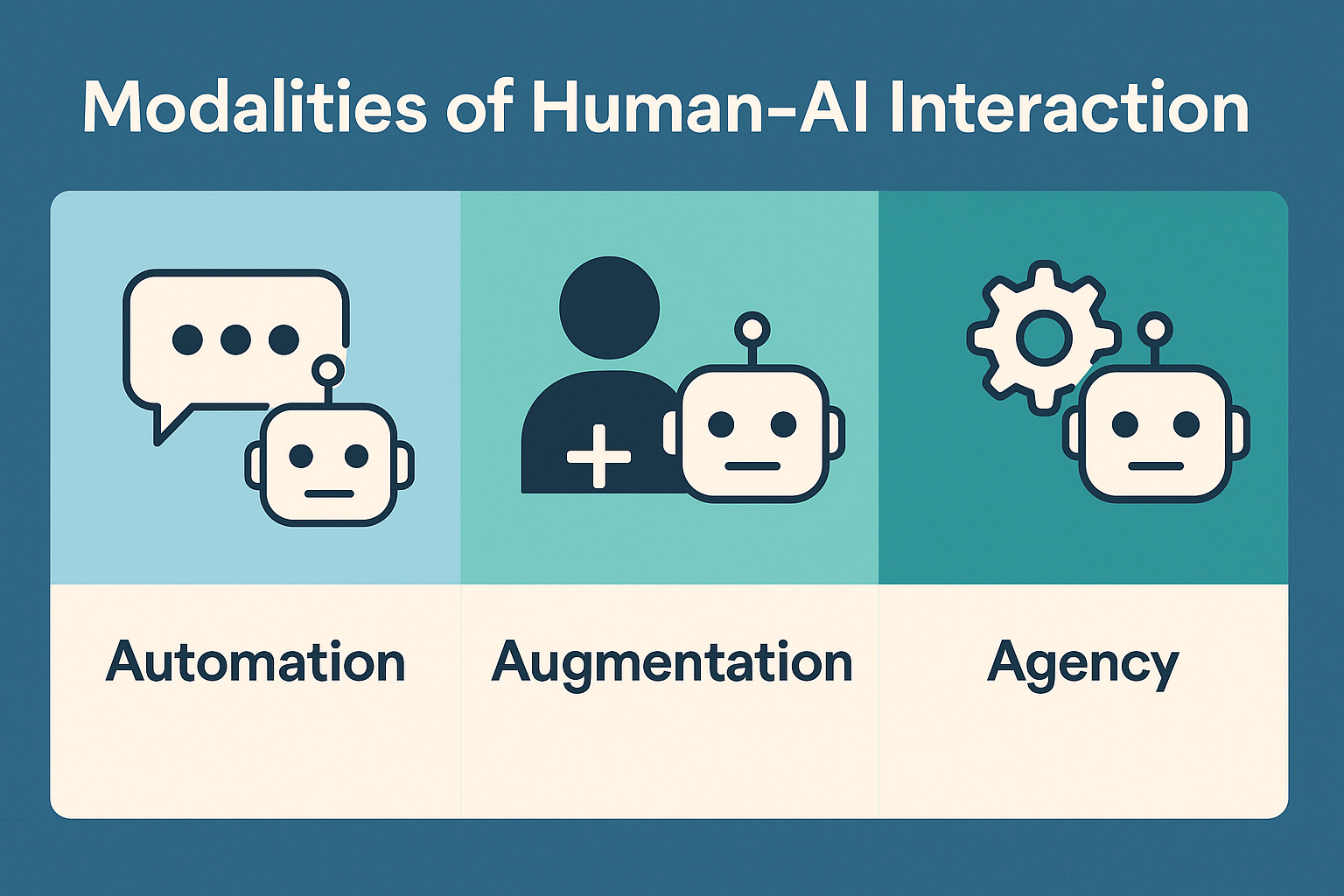
1. Automation
At the most basic level, we use AI by giving it instructions: a prompt, a command, a question.
This covers everything from Google-like queries and chatbots to coding assistants that help us write snippets of code.
2. Augmentation
The next stage is deeper collaboration. Here, AI isn’t just answering one-off questions — it becomes a partner across many interactions, sometimes hundreds, all in service of a bigger goal.
Examples include co-writing an article, building a story, or coding interactively with an AI assistant.
3. Agency
Finally, we arrive at a stage where AI can act on our behalf.
This is where “Agentic AI” comes into play — systems that plan, execute, and adapt independently, while still aligned with our objectives.
The paper concluded with outlining 4 core AI competencies (The 4 Ds). This framework enables AI practitioners to:
Understand if or when and how to use AI
Communicate effectively with AI
Asses the quality of AI outputs
Uphold ethical practice, transparency and accountability
The 4 Ds of AI Core Competencies
The paper concluded with outlining 4 core AI competencies (The 4 Ds). This framework enables AI practitioners to:
Decide if, when, and how to use AI.
Communicate effectively with AI systems.
Critically evaluate AI outputs.
Uphold ethical practice, transparency, and accountability.
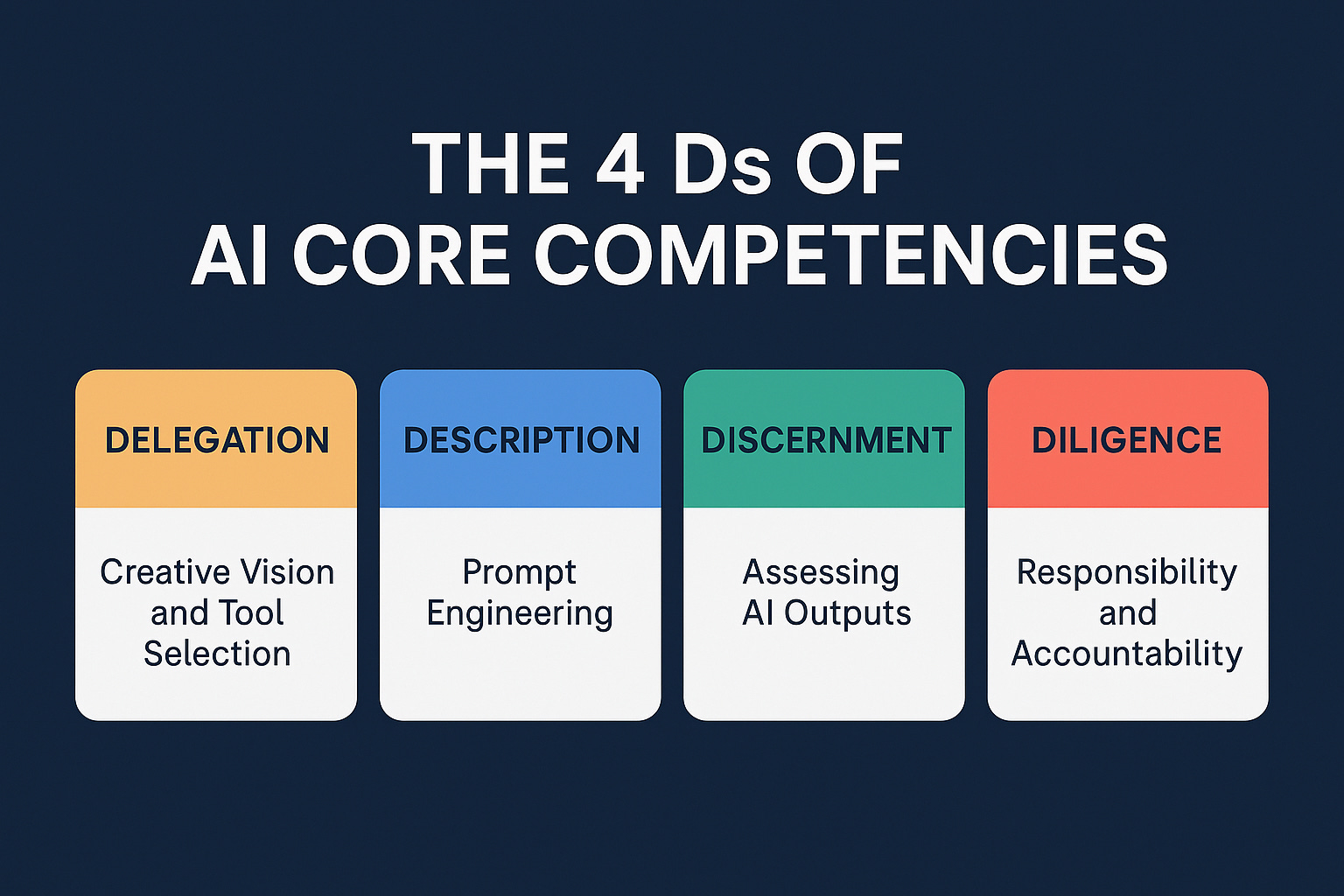
Here’s a closer look:
1. Delegation — Creative Vision and Tool Selection
Knowing when and how to bring AI into the process. This is about judgment: understanding which tools fit the task and how they can add the most value.
2. Description — Prompt Engineering
The art of communication. Translating human ideas, requirements, and constraints into effective inputs that AI can act on.
3. Discernment — Assessing AI Outputs
Critical evaluation of what AI produces. It’s not just about spotting errors or biases, but also about refining the back-and-forth collaboration between human and machine.
4. Diligence — Responsibility and Accountability
The ethical core. Ensuring transparency, fairness, and accountability in how AI is used, and taking ownership of the final outcomes.
From Delegation to Diligence, the 4 Ds offer a blueprint for building true AI fluency. They remind us that working with AI is not about replacement, but about augmentation — using AI to expand human creativity, judgment, and responsibility.
AI Fluency Course at Anthropic Academy
What is great about this is that Anthropic - the brain behind Claude -has taken the AI Fluency Framework developed by Rich and Joseph and turned it into a comprehensive learning program.
What makes it even better is that the professors themselves are part of the teaching team, bringing their research directly into practice.
The Academy offers a Foundations of AI Fluency Framework course for everyone, along with specialized tracks designed specifically for educators and students.
You will also get a Certification of Completion at the end of the course - great for adding to your achievements.
As I keep mentioning, AI won’t take your job, but someone who is Fluent in AI will!
Fluency is power. Learn the skills to collaborate, create, and lead in the age of AI.
Hi there, I’m Chris Prakoso.

I believe that AI isn’t here to replace us—it’s here to elevate us. In Augmented Humanity, I explore how AI, data, and emerging tech enhance human potential, reshape industries, and redefine human-machine collaboration.

Please subscribe, like, share and restack.